
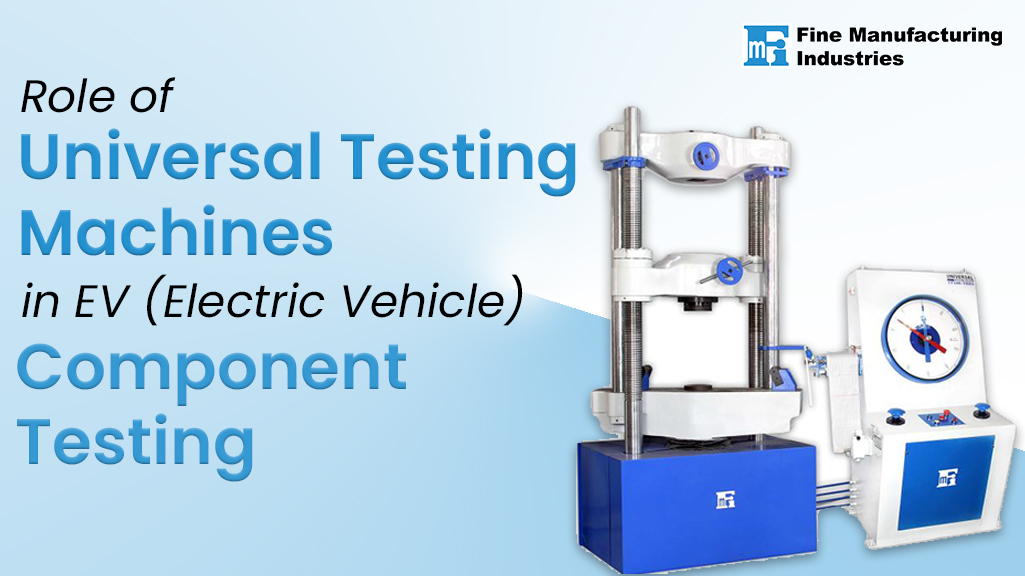
Role of Universal Testing Machines in EV (Electric Vehicle) Component Testing
The rapid growth of the electric vehicle (EV) industry is transforming the future of mobility. With increasing demand for safety, durability, and performance, manufacturers must ensure every EV component meets strict quality standards. This is where the Universal Testing Machine (UTM) plays a crucial role.
UTMs are widely used to test the mechanical strength and reliability of EV components, helping manufacturers deliver safe and high-performance electric vehicles. In this blog, we explore the importance, applications, and benefits of UTMs in EV component testing.
What is a Universal Testing Machine (UTM)?
A Universal Testing Machine (UTM) is a versatile testing system used to evaluate the mechanical properties of materials and components.
It can perform multiple tests such as:
- • Tensile testing
- • Compression testing
- • Bending (flexural) testing
- • Shear testing
Why EV Component Testing is Critical
Electric vehicles involve advanced materials and complex systems. Testing is essential to ensure:
- • Safety under stress and load
- • Durability over long-term use
- • Performance in different environments
- • Compliance with industry standards
Even small component failures can impact overall vehicle safety.
Role of UTM in EV Component Testing
UTMs help manufacturers analyze how EV components behave under different forces and conditions.
Key Roles:-
✔ Measure strength and durability
✔ Detect material weaknesses
✔Ensure product reliability
✔Support R&D and innovation
Key Applications of UTM in EV Industry
-
1. Battery Component Testing: UTMs test battery casings and structural parts for strength and deformation resistance.
Ensures safety in case of impact or stress.
2. Motor and Shaft Testing: Used to evaluate mechanical strength of motor components and shafts.
3. Fasteners and Joints: Tests bolts, nuts, and joints used in EV assembly.
Ensures strong and secure connections.
4. Chassis and Structural Parts: UTMs test vehicle frames and structures for load-bearing capacity.
5. Cable and Connector Testing: Evaluates tensile strength and flexibility of electrical cables.
6. Advanced Material Testing: Used for lightweight materials like composites and alloys.
Supports innovation in EV design.
Types of Tests Performed Using UTM in EVs
- • Tensile Test – Measures pulling strength
- • Compression Test – Evaluates resistance to crushing
- • Flexural Test – Checks bending strength
- • Shear Test – Tests resistance to sliding forces
These tests ensure components can withstand real-world conditions.
Benefits of Using UTM in EV Manufacturing
-
✔ Improves vehicle safety
✔Enhances product reliability
✔Supports lightweight material development
✔Reduces failure risks
✔Ensures compliance with global standards
How to Choose the Right UTM for EV Testing
-
✔ Load Capacity: Must match the testing requirements of EV components.
✔ Accuracy & Precision: High accuracy is essential for reliable results.
✔ Software Integration: Advanced software helps in data analysis and reporting.
✔Versatility: Ability to perform multiple tests.
✔Automation Level: Automated systems improve efficiency.
Latest Trends in UTM for EV Industry
- • Digital & Smart UTMs: Real-time monitoring and data analysis.
- • AI-Based Testing: Predictive analysis for material behavior.
- • High-Speed Testing Systems: Faster testing for mass production.
- • Integration with Industry 4.0: Connected systems for smart manufacturing.
Why UTM is Essential for EV Innovation
As EV technology evolves, manufacturers need reliable testing solutions to:
- • Develop safer batteries
- • Improve lightweight materials
- • Enhance structural performance
- • Meet global safety regulations
UTMs play a key role in driving innovation and quality in EV manufacturing.
Conclusion
The Universal Testing Machine is an essential tool in the EV industry, ensuring that every component meets the highest standards of
Investing in the right testing equipment ensures better product quality, reduced risks, and long-term success in the growing EV market.
FAQ
To test strength, durability, and reliability of EV components.
Battery parts, chassis, fasteners, cables, and structural components.
Tensile, compression, bending, and shear tests.
Yes, it ensures components can withstand real-world conditions.