
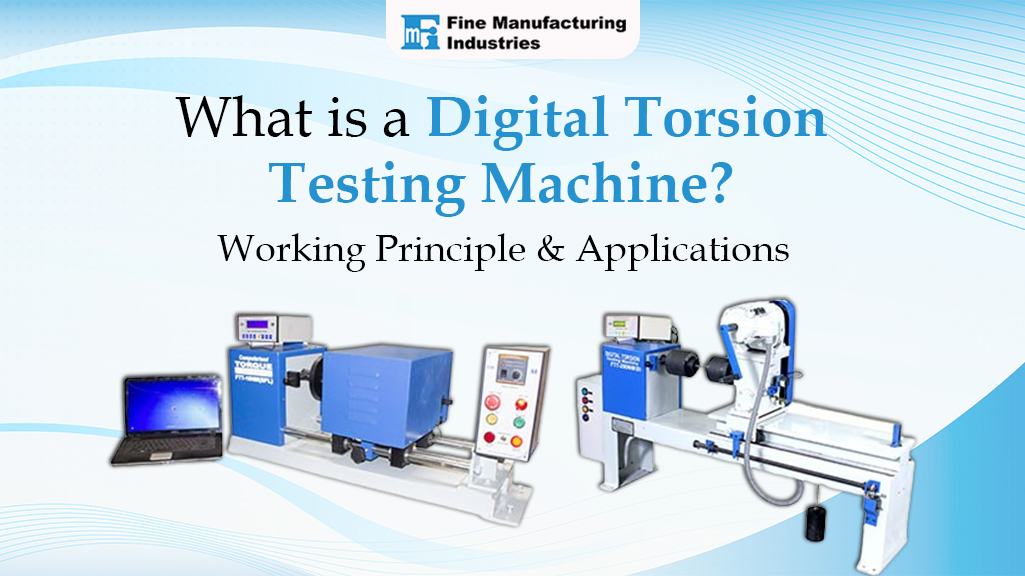
What is a Digital Torsion Testing Machine? Working Principle & Applications
In today’s industrial world, testing the strength and durability of materials is essential for ensuring product quality and safety. One important method used in material testing is torsion testing, which helps evaluate how a material behaves under twisting force.
A Digital Torsion Testing Machine is a modern testing device designed to measure how materials react when subjected to torque. It is widely used in industries to ensure that components can withstand real-world mechanical stress.
What is a Digital Torsion Testing Machine?
A Digital Torsion Testing Machine is a precision instrument that applies controlled twisting force (torque) to a material and measures its response.
It provides accurate digital readings such as:
- • Applied torque
- • Angle of twist
- • Maximum torsional strength
In simple terms, it twists a material until it deforms or breaks, helping engineers understand its strength and flexibility.
Working Principle of Digital Torsion Testing Machine
The machine works on a simple concept—apply torque and measure the resulting twist in the material.
How It Works:-
1. The specimen is fixed between two ends of the machine
2. One end remains stationary
3. The other end rotates to apply torque
4. Sensors measure torque and angle of twist
5. Results are displayed digitally in real time
Torsion Formula
T = \frac{G J \theta}{L}
Where:- • T = Torque applied
- • G = Modulus of rigidity
- • J = Polar moment of inertia
- • θ = Angle of twist
- • L = Length of specimen
This formula helps determine how much a material will twist under a given force.
Main Components of the Machine
- • Drive System – Applies rotational force
- • Gripping Mechanism – Holds the specimen firmly
- • Torque Sensor – Measures applied torque
- • Angle Indicator – Tracks deformation
- • Digital Display Panel – Shows accurate test results
Applications of Digital Torsion Testing Machine
- • Metallurgy – Used to study the strength and flexibility of metals.
- • Automotive Industry – Tests components like shafts, springs, and fasteners.
- • Aerospace Industry – Ensures materials can handle high stress and extreme conditions.
- • Manufacturing Sector – Used for quality control of wires, rods, and mechanical parts.
- • Research & Development – Helps in developing advanced materials and improving product design.
Advantages of Digital Torsion Testing Machine
-
✔ High precision and accuracy
✔ Real-time digital data output
✔ Easy to operate
✔ Reliable and repeatable results
✔Suitable for multiple materials
Digital vs Manual Torsion Testing Machine
| Feature | Digital Machine | Manual Machine |
|---|---|---|
| Accuracy | High | Moderate |
| Operation | Easy | Requires Skill |
| Data Recording | Automatic | Manual |
| Speed | Fast | Slow |
Digital machines are preferred in modern industries due to their efficiency and accuracy.
Key Factors to Consider Before Buying
- • Required torque capacity
- • Material and specimen size
- • Accuracy and resolution
- • Software and reporting features
- • Machine durability
Maintenance Tips
- • Perform regular calibration
- • Keep the machine clean
- • Inspect sensors and grips
- • Lubricate moving parts
- • Follow proper operating guidelines
Latest Trends in Torsion Testing
Conclusion
A Digital Torsion Testing Machine is an essential tool for evaluating how materials perform under twisting forces. Its ability to deliver accurate, reliable, and real-time results makes it indispensable in modern industries.
By choosing the right machine and maintaining it properly, businesses can ensure better product quality, safety, and long-term performance.
FAQ
It measures torque, angle of twist, and torsional strength of materials.
Wires, rods, shafts, and metal components.
It helps ensure material strength and product reliability.
Torque is the twisting force applied to an object.