
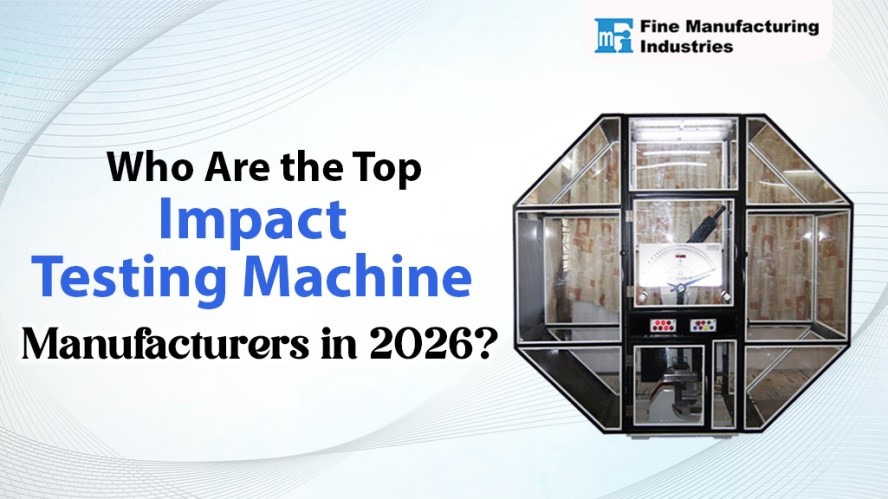
Who Are the Top Impact Testing Machine Manufacturers in 2026?
In the demanding realm of industrial quality control, the "fracture toughness" of a material subjected to sudden force is no longer a negotiable factor. As we continue into 2026, the need for high-speed and high-accuracy data has made the Impact Testing Machine more essential than ever before. Whether it is the specialized alloys employed in the aerospace industry or the recycled plastics in the sustainable automotive industry, it is the knowledge of "fracture toughness" that prevents failure in the real world.
For the lab manager and structural engineer, the choice of a manufacturer is a decision that invests in accuracy. Buying testing equipment from the world leaders at Fine Manufacturing guarantees that your plant is equipped with the latest advancements in motorized pendulum impact testing and digital data acquisition, keeping your manufacturing process in line with the latest international safety regulations.
What is an Impact Testing Machine?
An impact testing machine is a highly accurate device used to measure the energy absorbed by a material during the fracture process. The machine measures the toughness and brittleness of a material by striking a specimen with a heavy pendulum or a weight. Their application in 2026 includes:
- Standardized Testing (Charpy & Izod): Assisting the main impact testing techniques by measuring the resistance of metal and plastic specimens to the "V-notch" or "U-notch."
- Energy Absorption Measurement: Measuring the difference between the pendulum's potential energy before the drop and the pendulum's energy after impact.
- Safety-First Design: Having fully enclosed safety guards and interlocking doors to safeguard operators from high-speed debris.
- Digital Integration: Employing non-contact encoders and artificial intelligence software to deliver immediate, accurate results on high-resolution displays.
Why Leading Manufacturer Selection Matters in 2026
The world's demand for high-quality impact testers is fueled by the understanding that material integrity is directly related to a brand's legal and operational status.
1. Building a "Quality Firewall"
The best manufacturers in 2026 are essentially a "quality firewall" for the heavy industry. By offering machines that have a stiff frame and low energy loss, Fine Manufacturing, for example, ensures that the information you get is a reflection of the material, not a machine malfunction. This shield ensures that only tested and high-toughness materials make it to the assembly line.
2. Management of Regulatory Stress
Because of the increasing strictness of international standards such as ASTM E23 and ISO 148, using a low-quality machine is a recipe for disaster. The best manufacturers offer pre-calibrated and compliant machines that reduce the stress of failed audits and product recalls in highly regulated industries such as oil & gas and aerospace.
3. Improving Laboratory Throughput
Today’s modern testing laboratory faces the challenge of processing an ever-increasing number of samples within a shorter period of time. Features such as motorized pendulum lifting and automatic braking systems, found in the best 2026 models, reduce the strain on the operator and increase the speed of the testing process, enabling high-throughput quality control without compromising accuracy.
4. Cost-Efficiency and Longevity
Although cheaper options are available, they tend to have problems with friction losses and calibration drift. Spending money on a machine from the best manufacturer in the world will provide you with a guaranteed “total maintenance-free” experience and a lifespan of several decades, ensuring your laboratory has the highest possible Return on Investment (ROI).
What Goes On in Quality Manufacturing?
Fine Manufacturing’s engineering process for the production of impact testing machines involves the following to guarantee world-class performance:
- Metallurgical Stress Testing: The machine’s frame is made of high-quality steel to make sure it does not absorb the impact energy meant for the specimen.
- Precision Balancing: Pendulums are balanced to make sure the center of percussion matches exactly with the strike point.
- Friction Analysis: Using non-contact type encoders to remove mechanical friction in the measurement path.
- Safety Guard Integration: Installing large and transparent safety guards with electromagnetic interlocks for 360-degree protection of the operator.
- Calibration Verification: Each machine is screened for compliance with international standards before shipment to ensure accuracy right out of the box.
Who Benefits from Top-Tier Impact Testers?
High-precision impact testing is essential for various high-stakes sectors in 2026, including:
| Sector | Primary Application |
|---|---|
| Aerospace | Testing advanced composites and lightweight alloys for bird-strike resistance. |
| Automotive | Evaluating bumper and chassis materials for crash-safety compliance. |
| Construction | Verifying the toughness of structural steel used in high-rise buildings and bridges. |
| Metallurgy | Quality assurance for foundries and heat-treatment plants. |
| Defense | Testing armor plating and ballistic-resistant materials. |
Why Choose Fine Manufacturing?
As a world leader in the manufacturing of testing instruments, Fine Manufacturing is dedicated to the improvement of industrial safety through:
- Technological Innovation: We are at the forefront with motorized, computerized, and analogue-to-digital upgrade kits for all testing requirements.
- Global Compliance: Our products fully comply with the latest ASTM, BSEN, ISO, and IS norms.
- Strong Support: With civil foundation support advice through our service network, your machine will never be down.
- User-Friendly Approach: We focus on "one-operator" capability, simplifying complex tests to be fast, safe, and easy.
Conclusion
Selecting the right supplier for your impact testing requirements is an investment in the quality of your products. With the industrial sector advancing towards greater safety standards in 2026, the accuracy of your testing equipment will be your key to success. For a professional line of Impact Testing Machines that assure durability and accuracy, Fine Manufacturing is your reliable worldwide partner.
Frequently Asked Questions (FAQ)
The main difference is the location of the specimen. For Charpy, the specimen is held horizontally, while for Izod, it is held vertically in a clamped position. Most impact testing machines from major suppliers can easily switch between the two types of tests by merely changing the fixtures.
A motorized pendulum system automatically returns the pendulum to its original position after each strike, lessening the labor of the test operator and ensuring that the pendulum drop is consistent every time.
Windage loss refers to the air resistance opposing the swinging hammer. Major suppliers of impact testing machines have designed their hammers to be fully enclosed or aerodynamic to ensure that windage losses are constant and insignificant.
Yes. Single-stand machines enable fast and convenient specimen positioning removed from sub-zero cooling baths, ensuring that the test is completed before the specimen temperature increases.
Digital readouts do not suffer from human parallax error and have a higher resolution (up to 0.1 Joules), and hence are the preferred choice for modern R&D work and high-precision quality control.