
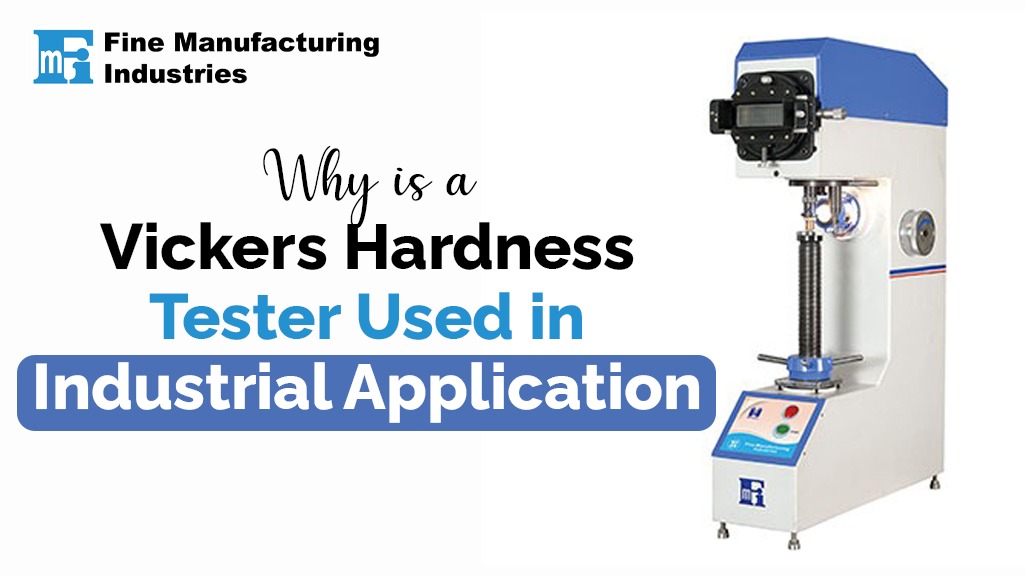
Why Is a Vickers Hardness Tester Used in Industrial Applications?
In the contemporary industrial setting, the quality of materials is the determining factor in the success and safety of the end product. Whether it is a micro-electronic device or an enormous aerospace turbine, the determination of the "hardness" of the material is of paramount importance. Among the numerous testing tools available, the Vickers Hardness Tester is one of the most widely employed and accurate devices used by engineers across the globe.
As industries strive to develop materials that are lighter, stronger, and more heat-resistant, the demand for precise measurement of material properties has shifted from a laboratory requirement to an industrial imperative. Obtaining high-precision testing equipment from reputable suppliers such as Fine Manufacturing ensures that companies can measure material properties with absolute certainty, thereby eliminating the risk of disastrous structural failure.
What is a Vickers Hardness Tester?
A Vickers Hardness Tester is a specialized hardness tester that measures the hardness of a material by applying a diamond indenter to the surface of the material. Unlike other hardness testers that may employ different procedures for different materials, the Vickers hardness tester employs a universal procedure. Its function includes:
- Universal Indentation: It employs a square-based pyramid diamond indenter with an angle of 136° between opposite faces.
- Wide Load Range: It can apply loads from a few grams (micro-hardness) to several kilograms (macro-hardness), making it applicable to almost all solid materials.
- Optical Precision: After the removal of the load, the diagonals of the square indentation are measured with a high-powered microscope to determine the Vickers Pyramid Number (HV).
- Non-Destructive Tendency: Since the indentation is very small, the test is often considered non-destructive for most finished industrial parts.
Why Vickers Testing Selection Matters
In the critical industrial setting, "approximate" data is not sufficient. The reason for the widespread use of the Vickers Hardness Tester is that accuracy is directly related to the reliability of the product and the reputation of the company.
1. Creating a "Quality Firewall"
The Vickers test is a "quality firewall" in the production process. It provides a very accurate reading of the surface hardness of the material. This ensures that the material has been heat-treated properly. This quality firewall prevents "soft" or "brittle" components from reaching the market, potentially leading to costly recalls or accidents.
2. Material Stress Management
Materials used in the automotive or military industries are subjected to extreme levels of operational stress. The Vickers technique enables "case depth" testing—testing the hardness from the surface to the core of the metal. This enables engineers to mitigate the risk of surface damage while retaining the required core strength.
3. Improving the Reliability of Industry
Reputation in the manufacturing industry is earned through reliability. The use of a Vickers Hardness Tester ensures that the results are consistent and universally accepted. This is important for companies that operate in the international market where the use of ISO or ASTM standards is mandatory.
4. Cost Savings and Risk Reduction
Although the machine requires a very accurate setup, it reduces the huge risks involved in the failure of materials. The machine allows manufacturers to detect defects at a microscopic level before the material is used in an assembly. This saves manufacturers millions of dollars in potential losses.
What Happens During Quality Testing?
At Fine Manufacturing, the design and use of our testers adhere to a strict protocol in order to ensure compliance with international industry standards:
- Diamond Calibration: Checking the geometry of the diamond tip to ensure a consistent indentation.
- Load Accuracy:Utilizing weight or electronic load cell systems to apply the precise amount of force necessary without oscillation.
- Microscopic Integration: Offering high-resolution optics to enable the user to measure the indentation diagonals with sub-micron resolution.
- Stress Simulation Mapping: Employing the tester to generate "hardness maps" of a cross-section of a sample to determine material consistency.
- Digital Integration: Contemporary testers now incorporate software for automatic measurement and data logging to remove human error.
Who Stands to Benefit from Vickers Hardness Testing?
Accuracy in hardness testing is critical to many high-tech and heavy industries, such as:
- Aerospace and Defense: Testing high-tech alloys and thin layers.
- Automotive Engineering: Hardness testing of gears, valves, and engine pins.
- Electronics and Micro-mechanics: Testing the properties of thin foils and small components.
- Heat Treatment Plants: Verifying the outcome of quenching and tempering processes.
- Research and Development: Testing new composite materials and ceramics.
Why Choose Fine Manufacturing?
As a major supplier of material testing equipment, Fine Manufacturing is dedicated to delivering the accuracy that today's industry requires through:
- Advanced Engineering: Our hardness testers are designed to withstand both the precision of laboratory testing and the ruggedness of the production environment.
- Technical Assistance: We assist our customers in understanding the subtleties of the Vickers scale to ensure they select the appropriate load values for their applications.
- Compliance Ready: Our testers are engineered to make it easy for you to comply with the most demanding international quality requirements.
- Innovative Solutions: From manual to fully automated systems, we can offer you customized solutions based on your production volume.
Conclusion
A Vickers Hardness Tester is an investment in the integrity of your brand. Whether you are testing a new alloy or simply checking your products on the assembly line, the accuracy of the Vickers test is second to none. For a professional line of testing equipment that promises accuracy and durability, Fine Manufacturing is your industrial partner of choice.
Frequently Asked Questions (FAQ)
Yes. Since the Vickers test allows for very low loads (micro-hardness testing), it is perfect for testing thin foils, wires, and surface coatings that would be damaged or crushed by other testing methods.
Rockwell testing is faster and uses a depth-of-penetration method, while Vickers is an optical method that is more accurate for a wider variety of materials and much smaller areas
Yes, because the indentation is optically measured, the surface finish is normally required to be polished or ground to a smooth finish to ensure that the edges of the indentation can be seen clearly.
Yes, theoretically. This is one of the biggest advantages of the Vickers test because the hardness number is independent of the load used, provided the material is homogeneous.
It is important to maintain the hardness tester by regularly calibrating it using certified test blocks and ensuring that the diamond indenter is clean and free of chips.